
I tried to make a small content site cleaner and more acceptable to AdSense. In the process, I weakened some of the affiliate paths that had started producing actual orders.
Search visibility continued. Amazon clicks fell. AdSense rejected the site again anyway.
That does not prove every link I removed was valuable. It does prove I changed too many connected parts of the site at once and then expected the dashboards to explain what happened. That was the expensive part of the lesson: not the lost clicks, but making my own evidence harder to trust.
What the Numbers Said
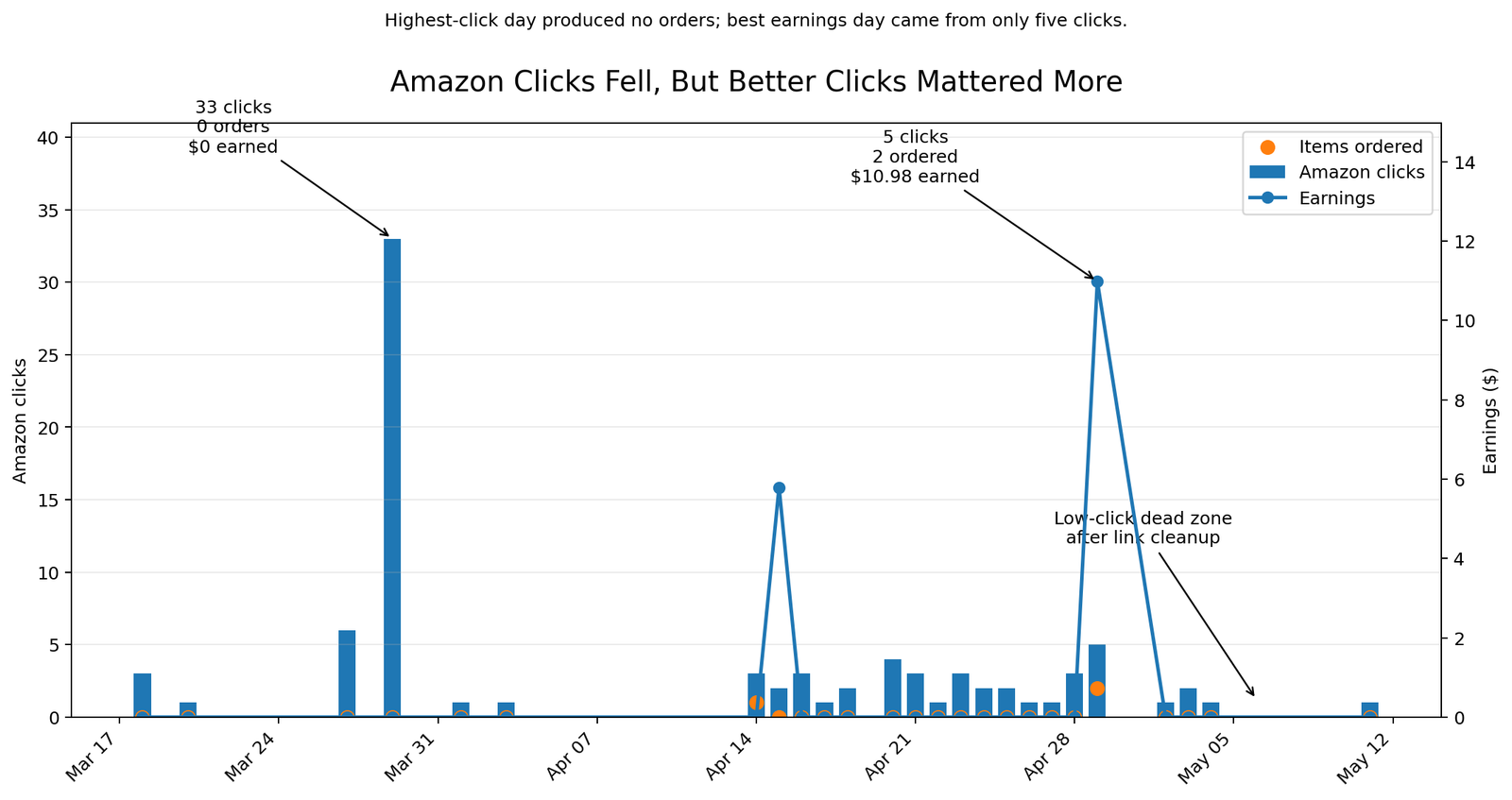
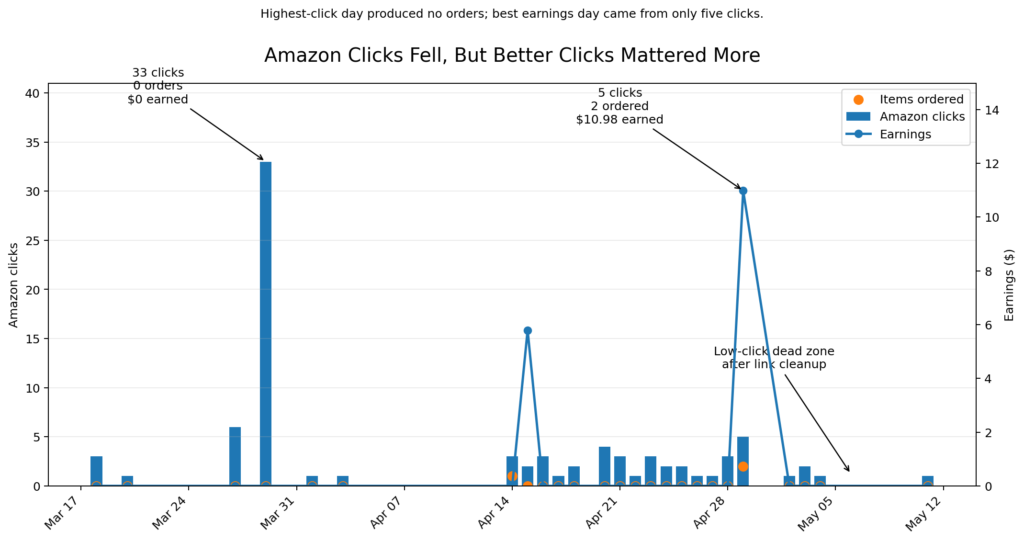
The highest-clicking Amazon day produced no orders. The best earnings day came from only five clicks. Raw affiliate clicks were not the useful signal. Reader intent, page purpose, and what happened after the click mattered more.
The larger mistake was treating affiliate cleanup as a sitewide switch. Some links needed to go. Others belonged on pages where readers were actively choosing a product. I removed both kinds while trying to solve a different problem.
What I Was Trying to Build
The site began in January as a small web-property experiment. The goal was to publish useful information, earn search visibility, and test several monetization paths without turning every page into a sales funnel.
The original plan divided readers into three broad groups:
| Reader | Possible Money Path |
|---|---|
| Someone looking for information | Display advertising |
| Someone comparing ordinary consumer products | Amazon Associates |
| Someone considering a higher-dollar purchase | A direct or specialized affiliate program |
The structure was reasonable. Different readers create value in different ways, and not every visit should end with a product click.
The sequencing became the problem. I treated AdSense approval as the first gate the site needed to clear. After repeated rejections, I began making the site look less Amazon-first.
What I Changed
The cleanup included removing affiliate links from some pages, reducing product blocks, and separating informational content from buying content.
Some of that work was necessary. A page helping someone understand or diagnose a problem should not immediately shove products across the table.
But I also weakened product paths on sizing and selection pages. Those readers were no longer asking only, “What is happening?” Some were asking, “What size or type should I buy?”
I cleaned the entire house when only a few rooms were messy. Efficient, technically. Wise, less so.
What the Amazon Numbers Showed
The dataset was small, but the contrast was useful:
| Date | Clicks | Ordered Items | Earnings |
|---|---|---|---|
| March 29 | 33 | 0 | $0.00 |
| April 14 | 3 | 1 | $0.00 pending shipment |
| April 15 | 2 | Shipped item | $5.79 |
| April 29 | 5 | 2 | $10.98 |
| May 2–11 | 5 total | 0 | $0.00 |
March 29 looked impressive until the second column met the third. Thirty-three clicks produced no orders.
April 29 produced only five clicks, but two items were ordered and the account recorded $10.98 in earnings.
The biggest click day made nothing. The best earnings day came from five clicks.
What Those Numbers Did Not Prove
This was not a controlled test. Several things changed during the same period, the traffic volume was low, and some Amazon activity may have included my own link testing and verification.
The data did not prove that one particular product link caused an order. It also did not prove that every removed link had been valuable. These are observations from one small live experiment, not universal conversion-rate rules.
What it did show was more limited and more useful:
- A large click count can produce no revenue.
- A small number of clicks can produce orders.
- Affiliate clicks and buyer intent are not interchangeable.
- Changing link placement can alter the money path even when the site still receives search exposure.
- A dataset this small should guide the next test, not support a victory speech.
Search Visibility Had Not Disappeared
During the same general period, Google Search Console reported 7.79K impressions, 17 clicks, a 0.2% click-through rate, and an average position of 24.7.
Those were early-site numbers, not evidence of a successful traffic business. They did show that Google was still displaying the site in search results while Amazon activity weakened.
That meant the affiliate decline could not be explained simply as “Google traffic vanished.” Something had changed between the search visit and the product action. My own cleanup work was an obvious part of that change.
The Actual Mistake
The mistake was not simply removing affiliate links. Some links deserved removal.
The mistake was applying one monetization rule across pages that served different readers at different stages of a decision.
| Page Job | Reader’s Likely Question | Reasonable Link Treatment |
|---|---|---|
| Diagnosis | What problem do I have? | Keep the page focused on diagnosis. |
| Explanation | How does this work? | Use product links only when they materially help. |
| Decision | Which approach fits my situation? | Limited product paths may support the decision. |
| Sizing or selection | What size or type should I choose? | Specific, relevant product paths can belong here. |
| Product-focused | Should I buy this particular item? | A clear product link is expected if the review is evidence-based. |
A diagnostic page and a sizing page can discuss the same subject without doing the same job. Treating them alike made the site cleaner in a mechanical sense, but less helpful at the point where some readers were ready to act.
Why AdSense Complicated the Decision
I was not removing links only to improve the pages. I was also trying to satisfy what I thought AdSense wanted from the site.
After the cleanup weakened Amazon activity, AdSense rejected the site again. That did not prove the cleanup caused the rejection or that affiliate links were irrelevant to the review. Google did not provide that level of explanation.
It did expose a bad operating assumption: approval from one monetization network should not dictate the structure of every page when that structure also affects other legitimate income paths.
AdSense remained one possible layer. It stopped being a reason to make useful selection pages less useful.
The Rule That Came Out of It
Diagnose first. Help the reader decide second. Present a buying path only when the page and the reader have reached that point.
That rule does not require hiding every affiliate link or adding more buttons. It requires giving each page a clear job.
- Keep diagnostic content focused on the problem.
- Use informational pages to explain, not manufacture urgency.
- Place product links where choosing a product is a natural next step.
- Prefer specific, relevant paths over broad marketplace links that make the reader restart the search.
- Disclose affiliate relationships before the first affiliate link.
- Judge links by usefulness and resulting behavior, not clicks alone.
The broader monetization rules now live under Affiliate Programs. The tools and platforms behind tracking, search measurement, hosting, and monetization are tracked separately on Tools.
What I Should Have Done Differently
I should have separated the work into smaller changes:
- Classify each page by its primary job.
- Remove weak or distracting links from diagnostic content.
- Leave qualified buying paths in place on selection pages.
- Record the starting traffic, click, order, and earnings data.
- Change one page group at a time.
- Allow enough activity to produce a useful signal before making the next change.
That would not have created perfect evidence. Small sites rarely provide enough traffic for clean laboratory results. It would have produced evidence that was less tangled than what I created.
Where This Fits in the Operating Math
A small content site belongs primarily in the long-term or compounding cash-flow lane. It does not solve an immediate cash shortage well.
| Part of the Work | What It Looked Like Here |
|---|---|
| Money in | Small, uneven affiliate earnings triggered by qualifying purchases. |
| Money out | Hosting, tools, subscriptions, content assets, and other operating costs. |
| Time | Writing, editing, link maintenance, analytics review, technical cleanup, and waiting for enough data. |
| Energy | Interpreting noisy signals and resisting the urge to rebuild the site after every disappointing dashboard. |
| Opportunity cost | Time spent tuning a future-income asset instead of performing work that pays immediately. |
Payment stopped when clicks did not become qualifying orders, items were not shipped, links disappeared, readers were not ready to buy, or traffic never reached the right page. The cash flow was irregular because none of those events happened on a dependable schedule.
That is why a content site should not be confused with emergency income. It may become an asset, but “may” is doing honest work in that sentence.
When the Experiment Stops Being Worth It
The stopping point is not one bad week or one rejected application. It arrives when the site repeatedly consumes more money, time, and attention than its traffic, learning value, or realistic income path can justify.
For this experiment, that means watching whether useful pages gain search exposure, whether buyer-intent pages produce qualified actions, and whether the work creates reusable value. If those signals remain absent after sustained testing, continuing would become habit rather than strategy.
Stopping, narrowing, or changing the monetization plan would not erase the work. It would mean the experiment answered the question.
How This Changed the Next Decision
The lesson was not “affiliate links are good” or “AdSense is bad.” Both statements are too simple to be useful.
The lesson was that monetization must follow page purpose and reader intent. A network’s approval process, an attractive click total, or one small earnings day cannot replace that judgment.
It also reinforced the ABC-eFlow Method: establish the baseline, identify the constraint, change fewer variables, count the full cost, and decide what evidence would justify continuing. That evidence-first diagnostic sequence is the operating method behind Fix.
This belongs in Lessons From the Field because the useful part was not the dashboard result. It was discovering that I had changed the system while pretending I was merely cleaning a few links.
What I Took From It
Thirty-three affiliate clicks made nothing. Five clicks produced the best earnings day in the sample.
Then I weakened some useful buying paths while trying to solve an AdSense problem and made the evidence harder to interpret by changing too much at once.
The repair was not “put links everywhere.” It was to give each page a job, place buying paths where they genuinely help, and stop treating every dashboard movement as a command from the mountain.
Last reviewed: August 23, 2026 — Q5 protected-evidence review