Affiliate programs are not just links you sprinkle onto a website after the useful part is finished. Once a site uses them seriously, they become an operating system with approvals, tracking, disclosures, merchant rules, broken-link maintenance, payout timing, reversals, and the uncomfortable fact that the site may earn more when the reader buys something.
That conflict is manageable when the rules are visible. ABC-eFlow treats affiliate programs as part of Run because the hard work begins after approval: place links where they genuinely help, keep the tracking path intact, reconcile what happened, and make sure commission potential never gets veto power over the reader’s best decision.
Affiliate income is referral income. The useful operating question is not “Which program pays the most?” It is “Can this program support a useful reader decision without creating more trust, tracking, permission, or maintenance risk than it is worth?”
What an Affiliate Program Actually Adds to the Operation
The simple definition is familiar: a publisher sends a reader to a merchant through a tracked link, and the publisher may receive compensation if the reader completes a qualifying action. The operating reality has more moving parts. The click has to be attributed correctly, the action has to qualify under program rules, the transaction has to survive cancellations or returns, the commission has to be approved, and the account has to reach whatever conditions trigger payment.
Approval Is the Beginning, Not the Finish Line
Getting accepted into a program proves very little about whether the relationship will be useful. Some programs are easy to join and difficult to monetize. Others require traffic, content quality, specific promotion methods, or a review of how the site presents itself. The operating burden can also change after approval when the merchant updates terms, changes commission rates, retires products, or tightens what kinds of traffic and claims are allowed.
The practical response is to record the program as an actual dependency. Keep the account owner, program or network, approved property, major restrictions, disclosure requirement, payout method, and review date somewhere you will still be able to find six months later. An affiliate relationship that exists only in somebody’s memory is already halfway to becoming a broken link with a password-reset problem.
Disclosure Is Part of the Link, Not a Legal Footnote
Readers should not have to reverse-engineer whether ABC-eFlow may benefit from a recommendation. The site-wide Affiliate Disclosure explains the overall relationship, but individual pages still need clear disclosure where compensated links appear. The disclosure should arrive before or close enough to the commercial path that the reader understands the relationship before acting.
Disclosure is not a punishment for monetizing useful work. It is part of keeping the recommendation legible. A reader can decide that a referral relationship is acceptable. What damages trust is making the relationship difficult to see while the page quietly nudges the reader toward the action that pays.
Put Affiliate Links Where Reader Intent Has Earned Them
The strongest affiliate placement usually appears after the page has done enough work to justify a commercial next step. A troubleshooting page may need to diagnose the problem without selling anything. A setup guide can mention a tool when the tool is actually required. A comparison or sizing page may reasonably help a reader choose among products. The intent of the page should decide the commercial pressure, not the availability of a commission.
The Tracking Chain Needs More Than a Click Counter
An affiliate click is only one event in a longer chain. A useful diagnosis separates page traffic, link visibility, link function, click volume, merchant attribution, conversion, approval, and payout. If clicks fall, the problem could be lower traffic, weaker buyer intent, a moved link, a broken redirect, a tracking parameter that disappeared, a merchant page that changed, or an editorial cleanup that removed the path readers actually used.
That distinction matters because the wrong diagnosis creates more damage. If traffic is healthy and clicks disappeared after a page edit, publishing ten new articles is not the first move. If clicks are steady but orders vanish, the problem may be product fit, merchant availability, price, attribution, or normal conversion noise. The evidence has to tell you which part of the chain changed.
A Real ABC-eFlow Failure Is More Useful Than a Perfect Funnel Diagram
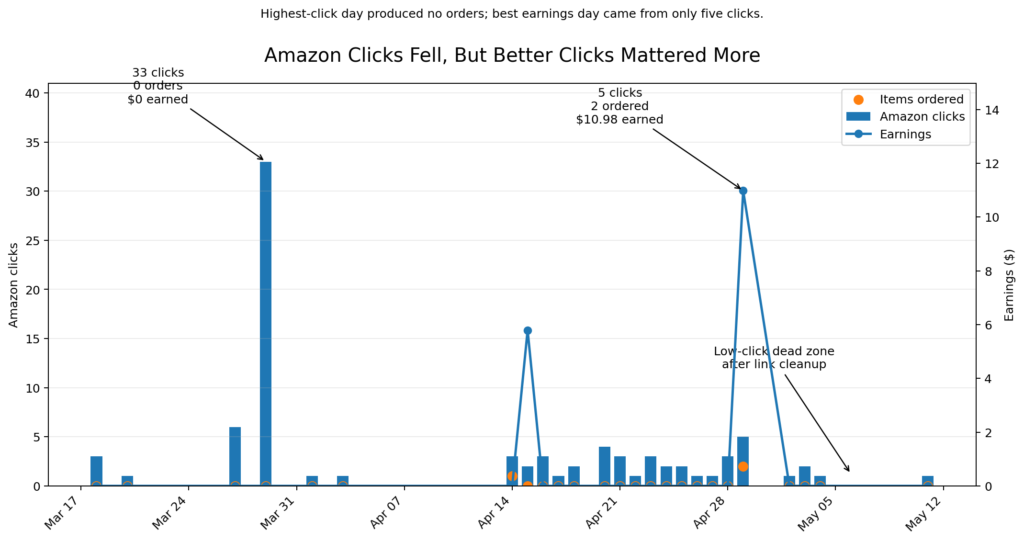
The affiliate-click Field Note exists because the clean version of this lesson would be less useful. Search visibility on a related project was improving while Amazon affiliate activity weakened. Product-link cleanup, ad-related changes, and page edits had altered parts of the buyer path. The result was not a neat single-cause failure, but it was enough to show why traffic, link placement, and commercial intent must be diagnosed separately.
The lesson was not “add more affiliate links.” It was that a useful site can become commercially toothless if monetization cleanup removes the paths that qualified readers were already using. The opposite failure is just as real: adding links everywhere can make a site less useful and less trustworthy. The operating job is to preserve the path where it belongs and leave it out where it does not.
Payout Timing Changes the Economics
Affiliate revenue should not be treated as immediately spendable simply because a dashboard shows a commission. Programs may hold transactions, wait through return periods, reverse invalid or refunded sales, require a minimum balance, or pay on a delayed schedule. That makes affiliate income especially poor as an emergency-cash plan and potentially useful only as one part of a longer-term property.
The same discipline used for small-business income applies here: gross commission is not automatically take-home cash. If the site has hosting, content, tools, paid services, taxes, or other operating costs, the real question is what remains after the system pays for itself and the payment actually arrives.
Permission Risk Deserves Its Own Decision
Some affiliate, creator, advertising, or brand platforms ask to connect social accounts, analytics, business pages, or other systems. The potential upside does not erase the access question. Before granting permissions, identify what the platform wants, whether the permission is required for the relationship you actually want, what data or control it receives, and how cleanly that access can be removed later.
The rule is the same one used on the Tools page: useful does not mean harmless. A program can be legitimate and still ask for more access than the expected value justifies.
Affiliate Links Require Maintenance
Affiliate content ages. Products disappear. Hosts change plans. Merchant pages move. Programs close. Commission terms change. A link that was a reasonable recommendation last year can become a dead end or a bad fit without anyone touching the article. That makes maintenance part of the cost of the program.
- Review the pages that actually generate affiliate clicks before spending time auditing every link equally.
- Confirm important merchant destinations still exist and the recommendation still matches the page.
- Keep sponsored/nofollow treatment and disclosures intact when links are edited.
- Remove or replace commercial links that no longer help the reader instead of preserving them because they once earned money.
- Record material changes so a later traffic or revenue shift can be tied to something more useful than memory.
Evidence Labels Protect the Recommendation
A tool mentioned on an affiliate page should carry the same evidence discipline used elsewhere on ABC-eFlow. USED means there is real operational experience. TESTED means the tool or service was deliberately evaluated but the experience is narrower. RESEARCHED means the page can discuss documented capabilities without pretending firsthand use. GENERAL OPTION means the category may solve the job, but there is not enough evidence to turn a product name into a recommendation.
Those labels matter more on monetized pages because an affiliate relationship can make ordinary wording sound like a stronger endorsement than the evidence supports. A disclosed referral link does not magically upgrade TESTED into USED. The recommendation should get stronger only when the evidence gets stronger.
The Commercial Math Still Has to Work
Affiliate income is often evaluated with the wrong denominator. A commission report can look encouraging while the site is carrying hosting, software, content work, image production, maintenance, taxes, and hours of troubleshooting that never appear in the affiliate dashboard. The program does not have to pay for the entire website by itself, but the site should know what role the revenue is actually playing.
A program can be worth keeping because it monetizes pages that already serve readers well, even if it is not a large revenue source. Another program can produce occasional commissions and still be a bad operating choice if it requires constant maintenance, weak content, risky permissions, or attention that would be better spent elsewhere. Revenue is evidence. It is not immunity from the rest of the method.
A Practical Affiliate Operating Checklist
1. Define the reader problem first. The page should have a useful job without the affiliate program.
2. Confirm the program fits the property, audience, and promotion method before applying.
3. Record approval, account ownership, important restrictions, payout terms, and review date.
4. Place the disclosure before or near the commercial path.
5. Use affiliate links only where the page has earned a commercial next step.
6. Verify the live link, tracking path, and destination after publishing or major edits.
7. Watch page traffic, clicks, conversions, reversals, and payout as separate signals.
8. Review meaningful links periodically and remove programs that create more friction, risk, or bias than value.
Bottom Line
Affiliate programs can support a useful website, but they do not turn weak content into a business and they should not be allowed to decide what the site says. The durable version is slower and less exciting: useful pages, qualified reader intent, transparent disclosures, functioning links, recorded program rules, sane permissions, and enough measurement to notice when one part of the chain breaks.
That is why Affiliate Programs lives under Run. Approval is not the finish line. The work is keeping the relationship useful, visible, trackable, and subordinate to the reader’s decision.
Primary Guidance
For U.S. endorsement and affiliate-disclosure guidance, see the Federal Trade Commission’s current endorsement guidance: FTC Endorsement Guides: What People Are Asking.