You do not need to become an accountant to keep useful small-business records.
You do need a system that clearly shows where income came from, what you spent to produce it, and where the supporting documents live.
The IRS says businesses may use a recordkeeping system suited to the business as long as it clearly shows income and expenses, except where particular rules require specific records. For a small small business, a spreadsheet plus an organized document folder may be enough to start.
Start Small
- One income log for money received.
- One expense log for money spent.
- One document structure for receipts, invoices, statements, and other support.
- One recurring review so missing information is found while it is still recoverable.
- Upgrade only when the simple system becomes the bottleneck.
If you first need to decide what documents belong in the system, use the Small-Business Recordkeeping Checklist. This page focuses on the running ledger.
The Minimum Useful Income Log
The purpose is not decoration. At the end of the month, you should be able to total income without opening twelve apps and hoping they all remember you.
The Minimum Useful Expense Log
For mixed personal and business expenses, the business or deductible portion may require allocation under the rules that apply. Do not assume the whole cell-phone bill, vehicle payment, home internet bill, or household purchase becomes a business expense because the small business touched it once.
Business-expense rules depend on the facts and the tax rules that apply. This page focuses on keeping records clear enough to support those decisions.
Track Gross, Fees, and Deposits Separately When They Differ
Some platforms and payment processors deposit an amount that is already reduced by fees. If you record only the bank deposit, the ledger can lose the gross transaction and the cost that reduced it.
A simple example:
The exact bookkeeping treatment depends on the system and business, but operationally you want enough detail to explain why the sales record and bank deposit differ. For the distinction between revenue and what you can actually keep, see Gross Income Is Not Take-Home Pay in a Small Business.
Keep Supporting Documents
The IRS notes that records can include invoices, receipts, deposit information, sales records, account statements, proof of payment, and other documents supporting income and expenses.
Use the current IRS Recordkeeping guidance and What kind of records should I keep? when deciding what support matters for federal tax records.
A simple digital structure might be:
2026 Small Business Records
  01 January
  02 February
  03 March
  ...
  Income
  Expenses
  Banking-Payments
  Vehicle-Travel
  Equipment
  Taxes
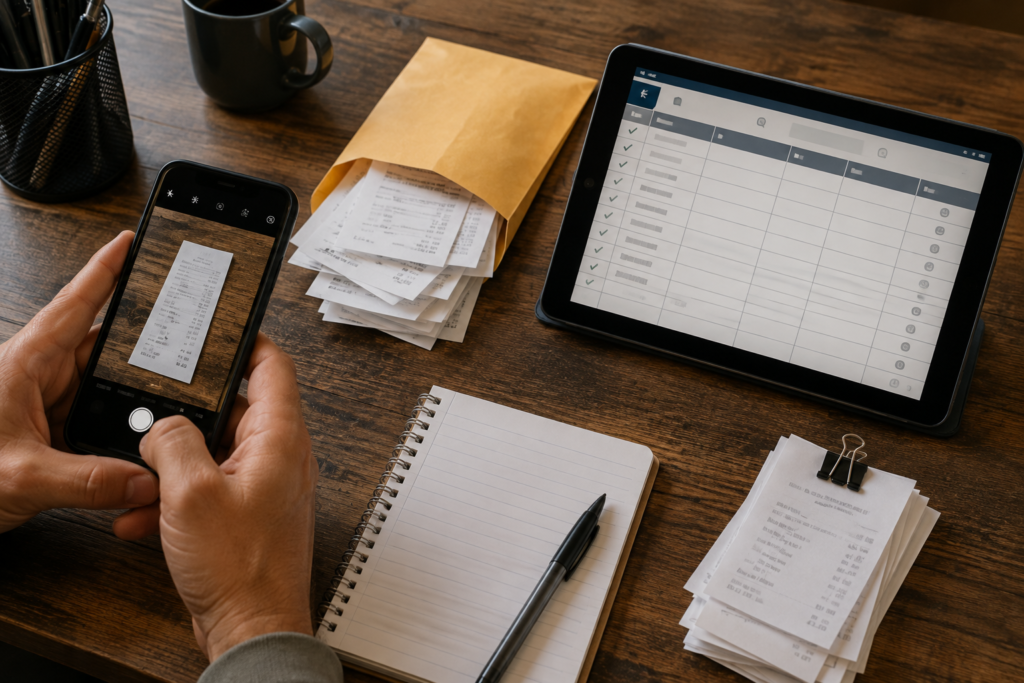
Take a picture of fading paper receipts when appropriate. Use filenames that mean something. “IMG_8472.jpg” is a storage method, but barely.
Record Transactions While They Are Fresh
The longer an entry waits, the more context disappears. Pick a rhythm that fits the volume:
- Five minutes after each job
- Ten minutes every Friday
- A scheduled weekly bookkeeping block
- Automatic import plus a weekly review if software is later justified
Monthly-only entry can work when transaction volume is tiny, but the longer you wait, the more likely a mystery charge becomes “probably business.”
Separate Business Activity Where Practical
Recordkeeping gets much easier when business income and expenses are not buried among hundreds of household transactions.
The Should You Use a Separate Bank Account for a Small Business? page explains the practical separation decision. Even without formal business banking, use a consistent payment path where possible so the ledger is not reconstructing the business from five cards, three apps, cash, and whatever happened to be closest to your hand.
Add Mileage and Travel Records Only When They Apply
Vehicle and travel records have specific tax rules. If the small business involves business driving, keep the mileage, purpose, dates, destinations, and other records required for your situation.
Do not invent mileage in April from memory and optimism. Review current IRS vehicle and travel guidance or ask a qualified tax professional when the treatment is unclear.
Reconcile the Ledger to Real Money
A spreadsheet can be perfectly organized and still be wrong. Periodically compare it against the accounts and platforms that actually moved the money.
- Do bank deposits match recorded income and payout reports?
- Did a platform deduct fees before deposit?
- Are refunds and chargebacks reflected?
- Did you record cash transactions?
- Are any receipts still sitting outside the system?
- Are there duplicate transactions from imports or manual entry?
Do a 15-20 Minute Monthly Close
- Total gross income.
- Total recorded business expenses.
- Check for missing receipts and documents.
- Compare deposits and payouts against the income log.
- Review unpaid invoices and open customer deposits.
- Update mileage, travel, asset, or inventory records that apply.
- Move or confirm the tax reserve.
- Record the month’s provisional net result.
- Record total hours if you are evaluating real hourly return.
This creates the operating baseline used in Money This Month, How to Plan Around Variable Small-Business Income, and Gross Income Is Not Take-Home Pay.
When a Spreadsheet Stops Being Enough
Upgrade the system when the current one creates errors, wastes time, or cannot support the actual operation.
Signals include:
- Many transactions across several accounts
- Inventory that must be tracked reliably
- Employees or contractors
- Sales-tax obligations
- Multiple business lines
- Frequent customer invoices and collection activity
- Difficulty reconciling bank and platform activity
- Too much manual duplicate entry
- A tax professional requesting cleaner or more detailed records
Use Tools for Running Small Businesses when a real operational need appears. The software should remove a proven bottleneck, not become a new hobby with monthly billing.
The Recordkeeping Checklist Behind the Ledger
The running ledger is only part of the record. Keep enough supporting material to explain what each money movement was and why it belonged to the business.
- Income records: invoices, platform statements, settlement reports, deposit records, and customer payment evidence where relevant.
- Expense records: receipts, invoices, order confirmations, statements, and notes that explain the business purpose when it is not obvious.
- Customer and project records: quotes, scope, approvals, change requests, delivery records, and payment terms for work where those records matter.
- Bank and processor records: statements from the accounts and payment services used by the operation.
- Vehicle or travel records: only when the activity actually requires them and the tax treatment applies.
- Equipment and asset records: purchase information, dates, cost, and disposition records for significant business property.
- Tax records: filed returns, forms received or issued, estimated-payment evidence, and the records supporting the numbers reported.
Record-retention rules depend on the record and why it matters. Use current IRS guidance and any applicable state requirements rather than a homemade universal “keep everything for X years” rule.
Gross Income Is Not Take-Home Pay
A deposit is not automatically money available to the owner. Use an operating waterfall:
Gross revenue → refunds/fees/direct costs → tax planning → near-term operating needs → owner or household money.
That sequence is not an accounting classification. It is a cash-control habit. It prevents the common mistake of treating every incoming dollar as spendable before the business has paid the costs created by earning it.
Payment timing can distort the month too. A customer may owe money that has not arrived, while a card processor may deposit a net amount after fees. Track what was earned, what was withheld, what was actually deposited, and what is still outstanding when those numbers differ materially.
Bottom Line
The best recordkeeping system for a small small business is not the fanciest one. It is the one you actually maintain and can use to explain the business.
Track income. Track expenses. Preserve support. Reconcile the ledger. Review the numbers regularly. Upgrade when the simple system stops being simple.
For the wider routine that connects records, payments, tools, and monthly review, return to Run.
Good records make tax filing easier, but they also tell you whether the small business is making money before tax season gets a vote.
Primary Guidance
The IRS allows businesses to choose a recordkeeping system suited to the business as long as it clearly shows income and expenses, subject to rules that apply to particular records. See IRS Recordkeeping and IRS Publication 583.